Song
Hey Diddle Diddle
The cat, the fiddle and the cow that jumped over the moon, remade for grown-up ears in three styles.
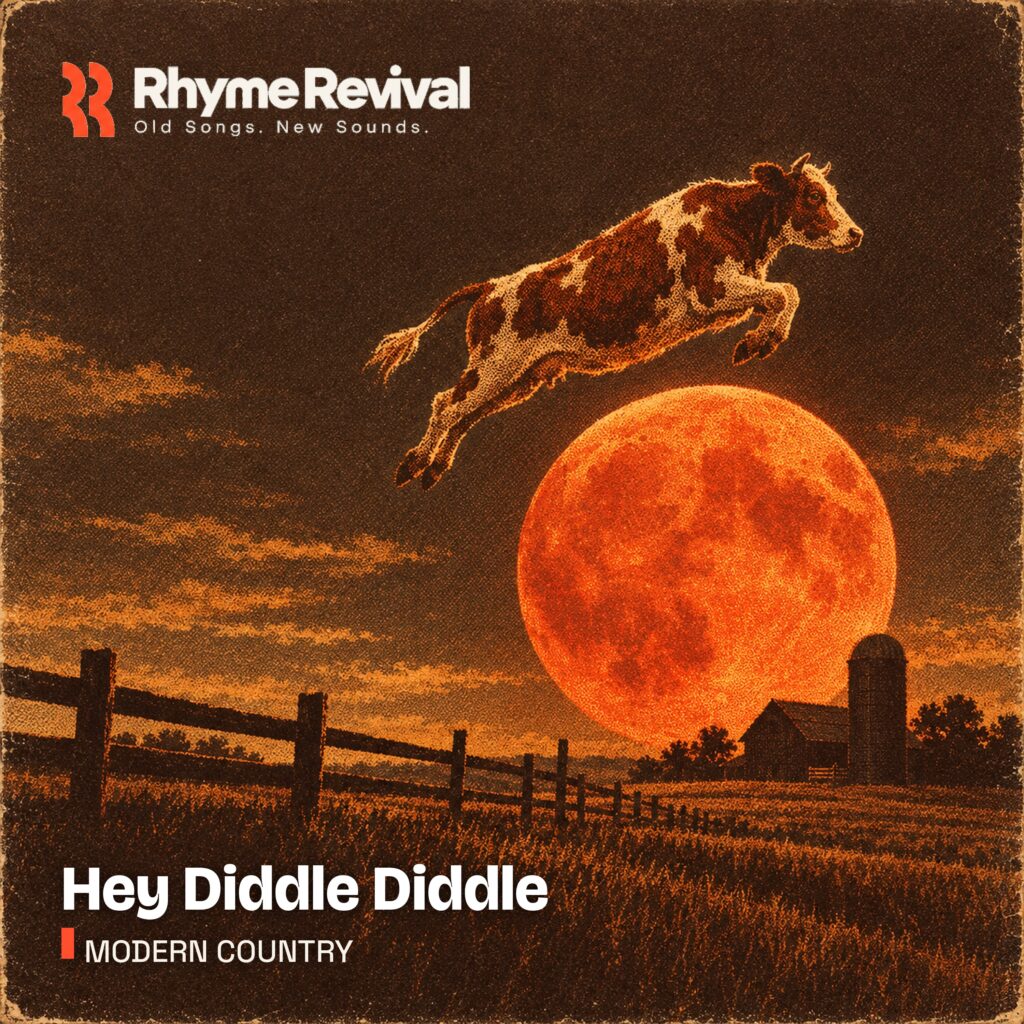
Modern Country version
Hey Diddle Diddle (Modern Country)
1 play
Also on
Produced by Rhyme Revival from the traditional public-domain lyrics.
Lyrics
Hey diddle diddle
The cat and the fiddle
The cow jumped over the moon
The little dog laughed to see such sport
And the dish ran away with the spoon
Hey diddle diddle
The cat and the fiddle
The cow jumped over the moon
The little dog laughed to see such sport
And the dish ran away with the spoon
Hey diddle diddle
The cat and the fiddle
The cow jumped over the moon
The little dog laughed to see such sport
And the dish ran away with the spoon
And the dish ran away with the spoon
The story of the song
Older than the cow and the moon
“Hey diddle diddle” was a phrase long before it was a nursery rhyme. A 1569 play by Thomas Preston mentions musicians who “can play a new dance called hey-diddle-diddle,” and “The Cat and the Fiddle” was a common inn name, with one recorded in London by 1587. Whether those are early traces of our rhyme or just the same playful words in the air is impossible to say.
First in print
The earliest version that clearly resembles the rhyme we know was printed in London in Mother Goose’s Melody, around 1765. It began “High diddle diddle” and came with a dry editorial joke: it must have been a little dog that laughed, because a great dog would be ashamed to laugh at such nonsense. The melody most of us sing was first recorded much later, by the composer and collector James William Elliott in his National Nursery Rhymes and Nursery Songs of 1870.
A magnet for theories
Few rhymes have attracted more explanations. Writers have tied it to Elizabethan court intrigue, Egyptian goddesses, a Greek chorus and the night sky, with the cat, cow and dog cast as constellations. Most of these theories have been discredited or have no evidence behind them. The scholars Iona and Peter Opie, the standard authorities on nursery rhymes, concluded it is most likely what it sounds like: joyful nonsense. Tolkien enjoyed the theories so much that he invented his own, a longer “original” poem that Frodo sings at the inn in Bree, in The Fellowship of the Ring.
A phrase we still use
The rhyme left a mark on everyday English. When we say someone is “over the moon,” we are borrowing from that cow.
What is uncertain
The 1569 and 1597 references may or may not be early forms of this rhyme. Theories linking it to historical figures, Egyptian or biblical sources, or constellations are unproven, and most have been discredited. The c. 1765 date for Mother Goose's Melody is approximate.
Sources
- Hey Diddle Diddle, Wikipedia: https://en.wikipedia.org/wiki/Hey_Diddle_Diddle
- Iona and Peter Opie, The Oxford Dictionary of Nursery Rhymes (1977), p. 202
- Mother Goose's Melody (London, c. 1765; facsimile, A. H. Bullen, 1904)
- J. J. Fuld, The Book of World-Famous Music (5th ed., 2000), p. 502
- C. R. Wilson and M. Calore, Music in Shakespeare: A Dictionary (2005), p. 171
- Julia Cresswell, Oxford Dictionary of Word Origins (2010), p. 279
- Roud Folk Song Index no. 19478, Vaughan Williams Memorial Library: https://www.vwml.org/
Explore with AI
Take this song further in your own AI assistant. The prompt below asks for documented history with sources and includes the version you are listening to.
Listener reviews
Write a reviewNo reviews yet. Be the first to share what you think.
More songs
All music

Follow @rhymerevival
Catch new releases, first listens and the stories behind the songs on Instagram and Facebook.
Join the Revival
One email when a new song or genre version is released. No spam, and free downloads never require signing up.