Song
The Grand Old Duke of York
Ten thousand men marching up the hill and back down again, reimagined in three styles.
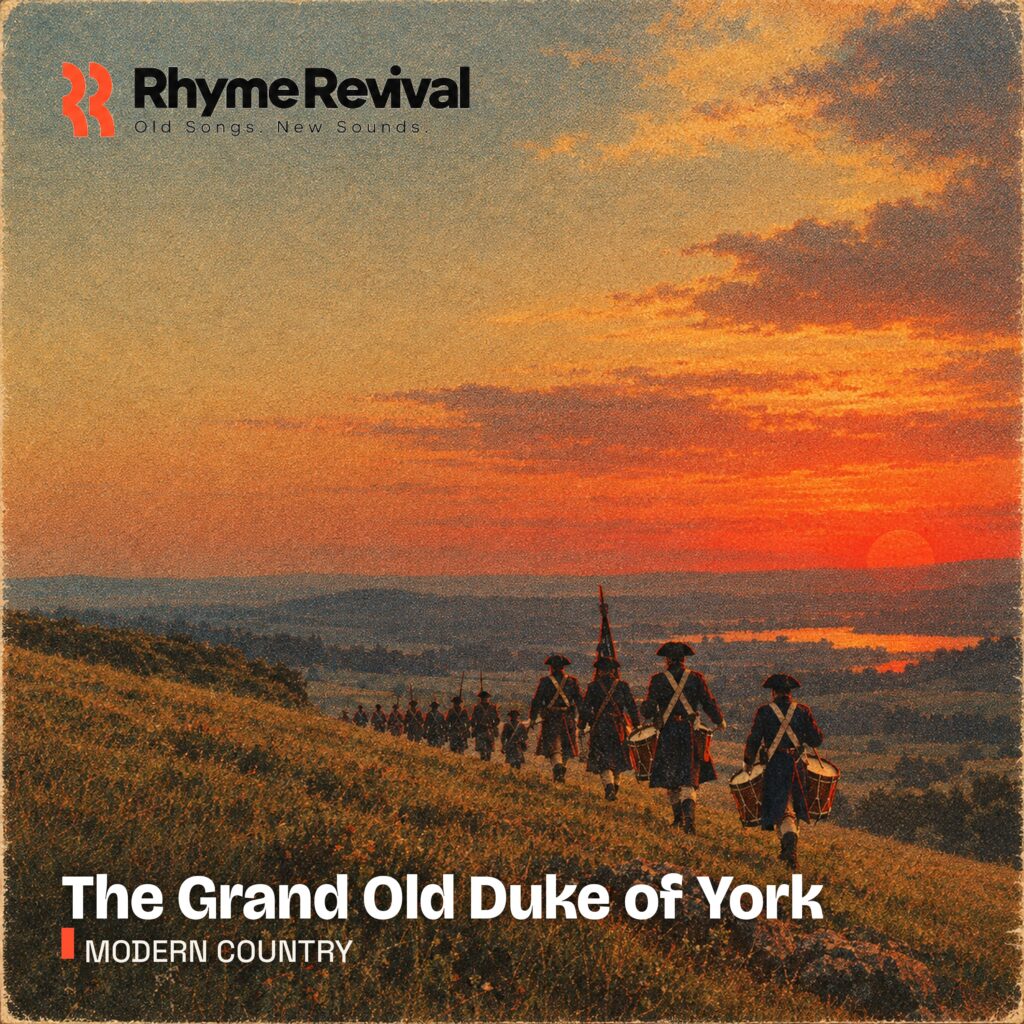
Modern Country version
The Grand Old Duke of York (Modern Country)
1 play
Also on
Produced by Rhyme Revival from the traditional public-domain lyrics.
Lyrics
Oh, the grand old Duke of York
He had ten thousand men
He marched them up to the top of the hill
And he marched them down again
And when they were up, they were up
And when they were down, they were down
And when they were only halfway up
They were neither up nor down
Oh, the grand old Duke of York
He had ten thousand men
He marched them up to the top of the hill
And he marched them down again
And when they were up, they were up
And when they were down, they were down
And when they were only halfway up
They were neither up nor down
They were neither up nor down
The story of the song
It started with a king
The oldest surviving version of this marching rhyme is not about a duke at all. A 1642 text called “Old Tarlton’s song,” credited to the Elizabethan stage clown Richard Tarlton, has “The King of France with forty thousand men” marching up a hill and coming down again. The joke, an army marched somewhere for no good reason, worked on any leader, and the rhyme seems to have been refitted for whoever deserved it.
Many dukes, no proof
As the King of France gave way to the Duke of York, people went looking for the real duke. Three candidates come up most often. Richard, Duke of York, led his army out of Sandal Castle at the Battle of Wakefield in 1460 and died there. James II, once Duke of York, marched troops to Salisbury Plain in 1688 and then pulled them back as his support collapsed. The most popular choice is Prince Frederick, Duke of York, son of George III, whose 1793 to 1794 campaign in Flanders ended in retreat; some point to the hill at Cassel. The honest answer is that no outside evidence ties the rhyme to any of them.
The words we know
Singers in Warwickshire were still using both the Duke and the King of France in 1892, and by 1894 some were singing it about Napoleon. The modern words did not settle into print until Arthur Rackham’s illustrated Mother Goose in 1913. It is often sung to the tune of “A-Hunting We Will Go,” and generations of us learned it standing up, sitting down and standing halfway.
Still marching
The rhyme even crossed the North Sea. A Dutch version swaps in Maurice, Prince of Orange, and is well known in Dutch scouting.
What is uncertain
No external evidence links the rhyme to any specific Duke of York. Prince Frederick is the most common attribution but is unproven. The 1642 text is credited to Richard Tarlton, who died in 1588, so the attribution itself is uncertain.
Sources
- The Grand Old Duke of York, Wikipedia: https://en.wikipedia.org/wiki/The_Grand_Old_Duke_of_York
- "Old Tarlton's song" (1642), attributed to Richard Tarlton
- Arthur Rackham, Mother Goose: The Old Nursery Rhymes (1913)
- Iona and Peter Opie, The Oxford Dictionary of Nursery Rhymes (1951; rev. 1997)
- Roud Folk Song Index no. 742, Vaughan Williams Memorial Library: https://www.vwml.org/
Explore with AI
Take this song further in your own AI assistant. The prompt below asks for documented history with sources and includes the version you are listening to.
Listener reviews
Write a reviewNo reviews yet. Be the first to share what you think.
More songs
All music

Follow @rhymerevival
Catch new releases, first listens and the stories behind the songs on Instagram and Facebook.
Join the Revival
One email when a new song or genre version is released. No spam, and free downloads never require signing up.