Song
Old MacDonald Had a Farm
A farmyard song with roots in a 1706 English opera, now one of the best known animal songs in the world.
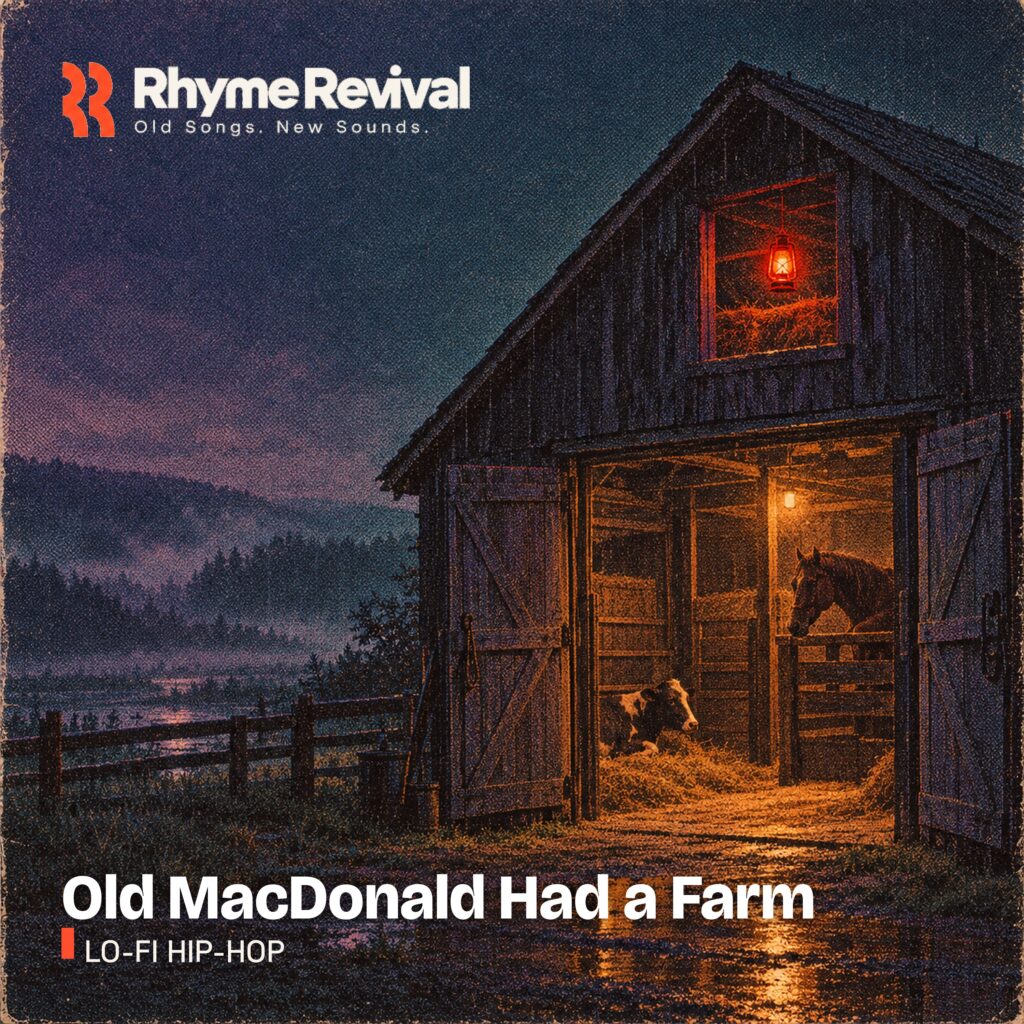
Lo-Fi Hip-Hop version
Old MacDonald Had a Farm (Lo-Fi Hip-Hop)
13 plays
Also on
Produced by Rhyme Revival from the traditional public-domain lyrics.
Appears on the album Lo-Fi Nursery Rhymes
Lyrics
Old MacDonald had a farm, E-I-E-I-O
And on that farm he had a cow, E-I-E-I-O
With a moo-moo here and a moo-moo there
Here a moo, there a moo, everywhere a moo-moo
Old MacDonald had a farm, E-I-E-I-O
Old MacDonald had a farm, E-I-E-I-O
And on that farm he had a pig, E-I-E-I-O
With an oink-oink here and an oink-oink there
Here an oink, there an oink, everywhere an oink-oink
Old MacDonald had a farm, E-I-E-I-O
Old MacDonald had a farm, E-I-E-I-O
And on that farm he had a duck, E-I-E-I-O
With a quack-quack here and a quack-quack there
Here a quack, there a quack, everywhere a quack-quack
Old MacDonald had a farm, E-I-E-I-O
Old MacDonald had a farm, E-I-E-I-O
And on that farm he had a horse, E-I-E-I-O
With a neigh-neigh here and a neigh-neigh there
Here a neigh, there a neigh, everywhere a neigh-neigh
Old MacDonald had a farm, E-I-E-I-O
Old MacDonald had a farm, E-I-E-I-O
And on that farm he had a sheep, E-I-E-I-O
With a baa-baa here and a baa-baa there
Here a baa, there a baa, everywhere a baa-baa
Old MacDonald had a farm, E-I-E-I-O
Old MacDonald had a farm, E-I-E-I-O
The story of the song
An opera song from 1706
The earliest known relative of “Old MacDonald” is “In the Fields in Frost and Snow,” from Thomas d’Urfey’s 1706 opera Wonders of the Sun. The singer milks his father’s cows to a chorus of “Boo” sounds, with a verse pattern and changing animals much like the song we know, though the melody was different and in a minor key. The opera flopped, but the song lived on. It was printed in d’Urfey’s Pills to Purge Melancholy in 1719 and turned up in John Gay’s Polly in 1729.
Many farmers before MacDonald
Folk collectors found the song all over England in different forms. Percy Grainger collected “Father’s Wood I O” in Lincolnshire in 1906, and Cecil Sharp heard “The Farmyard” from a 74 year old woman in a London workhouse in 1908. A 1917 collection of First World War songs called the farmer “Old Macdougal,” and an Ozark version from Missouri named the parts of a mule instead of a parade of animals.
The name and the tune arrive
The familiar tune and the name “Old MacDonald” may first appear on records from the 1920s: the Sam Patterson Trio’s 1925 recording on the Edison label and Gid Tanner and His Skillet Lickers’ version in 1927. Where that tune and name came from is still unknown.
A song that keeps growing
Many versions are cumulative, adding each new animal sound to the ones before it, which is why the last verse is always the loudest.
What is uncertain
It is not known whether d'Urfey wrote the 1706 song or adapted a traditional one already in circulation. The source of the modern tune and the name Old MacDonald is also unknown; the 1925 and 1927 recordings are only the earliest known examples.
Sources
- Old MacDonald Had a Farm, Wikipedia: https://en.wikipedia.org/wiki/Old_MacDonald_Had_a_Farm
- Thomas d'Urfey, Wit and Mirth, or Pills to Purge Melancholy, vol. 2 (1719)
- Roud Folk Song Index no. 745
Explore with AI
Take this song further in your own AI assistant. The prompt below asks for documented history with sources and includes the version you are listening to.
Listener reviews
Write a reviewNo reviews yet. Be the first to share what you think.
More songs
All music
Follow @rhymerevival
Catch new releases, first listens and the stories behind the songs on Instagram and Facebook.
Join the Revival
One email when a new song or genre version is released. No spam, and free downloads never require signing up.