Song
Baa, Baa, Black Sheep
A one verse rhyme first printed around 1744 whose words have barely changed in more than 250 years.
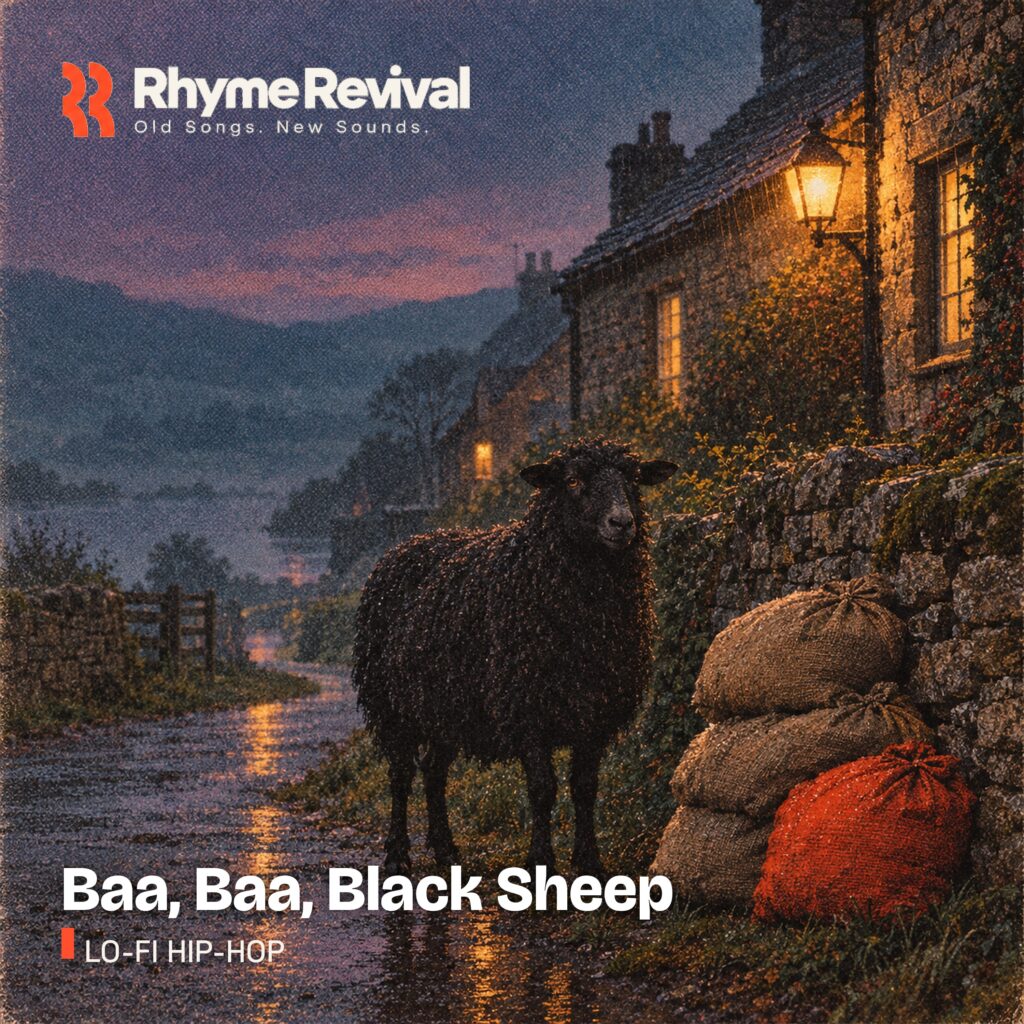
Lo-Fi Hip-Hop version
Baa, Baa, Black Sheep (Lo-Fi Hip-Hop)
8 plays
Also on
Produced by Rhyme Revival from the traditional public-domain lyrics.
Appears on the album Lo-Fi Nursery Rhymes
Lyrics
Baa, baa, black sheep
Have you any wool?
Yes sir, yes sir
Three bags full
One for the master
And one for the dame
And one for the little boy
Who lives down the lane
Baa, baa, black sheep
Have you any wool?
Yes sir, yes sir
Three bags full
One for the master
And one for the dame
And one for the little boy
Who lives down the lane
Baa, baa, black sheep
Have you any wool?
Yes sir, yes sir
Three bags full
One for the master
And one for the dame
And one for the little boy
Who lives down the lane
And one for the little boy
Who lives down the lane
The story of the song
Printed around 1744
“Baa, Baa, Black Sheep” first appeared in Tommy Thumb’s Pretty Song Book around 1744, beginning “Bah, Bah, a black Sheep.” The next surviving printing, in Mother Goose’s Melody around 1765, had a sadder ending: “But none for the little boy who cries in the lane.” Apart from that, the words have barely changed since.
A familiar melody
The rhyme is sung to a version of the 18th century French tune “Ah! vous dirai-je, maman,” the same melody used for “Twinkle, Twinkle, Little Star” and “The ABC Song.” Words and music were first printed together in Philadelphia in 1879 in A. H. Rosewig’s Nursery Songs and Games.
A song with a computing first
In 1951, “Baa Baa Black Sheep” was among the first songs ever played by a computer, alongside “In the Mood” and “God Save the King.” The rhyme has also travelled widely: in Sweden it became “Bä, bä, vita lamm,” with a white lamb in place of the black sheep.
About those three bags
Writers have tied the rhyme to a medieval wool tax, but no evidence connects the two. It may simply celebrate black wool, which could be woven into dark cloth without dye.
What is uncertain
Theories that the rhyme protests the 1275 wool tax or refers to slavery have no supporting historical evidence. The wool tax reading was first proposed in 1930, nearly two centuries after the rhyme was printed.
Sources
- Baa, Baa, Black Sheep, Wikipedia: https://en.wikipedia.org/wiki/Baa,_Baa,_Black_Sheep
- Tommy Thumb's Pretty Song Book (London, c. 1744)
- Iona and Peter Opie, The Oxford Dictionary of Nursery Rhymes (1951)
- Roud Folk Song Index no. 4439
Explore with AI
Take this song further in your own AI assistant. The prompt below asks for documented history with sources and includes the version you are listening to.
Listener reviews
Write a reviewNo reviews yet. Be the first to share what you think.
More songs
All music
Follow @rhymerevival
Catch new releases, first listens and the stories behind the songs on Instagram and Facebook.
Join the Revival
One email when a new song or genre version is released. No spam, and free downloads never require signing up.